Ask any G1 driver which part of the road test scares them most. Very often, the answer is parallel parking.
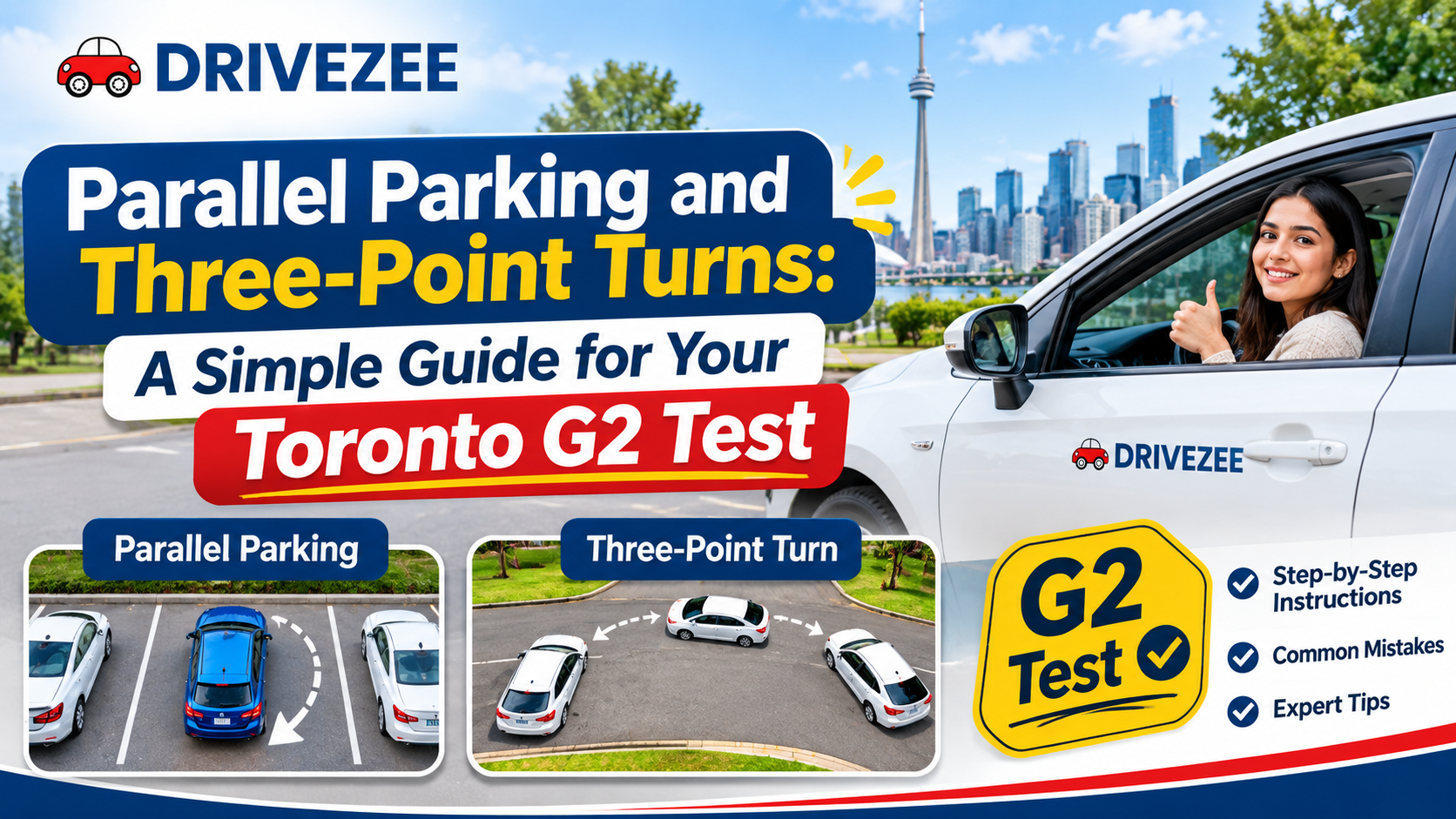
Here is the quick answer. To parallel park in Ontario, pull up beside the car in front of the space, leaving about 1 meter of room. Back up slowly with the wheel turned fully toward the curb. Straighten out, then turn fully away from the curb to slide in. Finish within about 30 centimeters of the curb.
This guide is for G1 drivers getting ready for the G2 road test in Toronto. We break both moves into simple steps and show the mistakes that cost marks. We also share how to practice them during car driving lessons in Toronto.
Key Takeaways
- Parallel parking and three-point turns are both part of the Ontario G2 road test.
- Look for a space about 1.5 times the length of your car.
- Always signal, check mirrors, and shoulder check before you move.
- Finish no more than about 30 cm from the curb.
- Go slow. Speed causes most parking mistakes, not steering.
In This Guide
- Is parallel parking on the G2 test in Toronto?
- How to parallel park in 7 steps
- How to do a three-point turn in 4 steps
- Common mistakes that cost marks
- How to practice in Toronto
- Your parking practice checklist
- Frequently asked questions
Is Parallel Parking on the G2 Test in Toronto?
Yes. The Government of Ontario lists parallel parking and three-point turns among the skills tested on the G2 road test. Other skills include turns, stops, lane changes, one-way streets, and residential driving (Ontario.ca).
The full G road test is a bit different. At full-time DriveTest Centres, the G test no longer includes parallel parking or three-point turns (part-time Travel Point locations still use the standard test). So the G2 test is where you need to nail them.
The G2 road test fee is $53.75, and the first attempt is already part of your G1 package (DriveTest Ontario). If you fail, you pay again and wait for a new date. That alone makes practice worth it.
How to Parallel Park in 7 Steps
These steps follow the Official MTO Driver’s Handbook. Read them once, then practice them with your instructor.
Step 1: Find the space and line up
Pick a space about 1.5 times your car’s length. Check traffic ahead and behind. Signal right. Pull up beside the car in front of the space, about 1 meter away from it. Stop when your rear bumper lines up with its rear bumper.
Step 2: Reverse and turn toward the curb
Shoulder check. Back up slowly while turning the wheel fully toward the curb.
Step 3: Straighten the wheels
When you can see the back outside corner of the car in front of the space, straighten your wheels. Keep backing up slowly.
Step 4: Turn away from the curb
Turn the wheel fully away from the curb. This swings the front of your car into the space.
Step 5: Fix your position
If you are not parallel to the curb, pull forward a little to straighten out. Aim to stop about 30 cm from the curb.
Step 6: Secure the car
Set the parking brake and shift into park.
Step 7: Exit safely
On test day, the examiner will tell you what to do next. In real life, turn off the engine, check traffic before opening your door, and lock the car.
How to Do a Three-Point Turn in 4 Steps
A three-point turn lets you turn around on a narrow street. Start from the right side of the road. Never try it on a curve, a hill, near a railway crossing, or anywhere your view is blocked (Official MTO Driver’s Handbook).
- Go forward and left. Signal left. When traffic is clear both ways, move forward slowly while turning the wheel sharply left. Stop before you touch the far curb.
- Shift into reverse. Stop fully first.
- Back up and right. Signal right. Check that the road is still clear. Turn the wheel sharply right and back up slowly toward the other side. Look over your shoulder, not just at the backup camera.
- Go forward. Stop, shift into drive, check traffic again, and drive away.
Common Mistakes That Cost Marks
| Mistake | How to fix it |
| No signal before moving | Signal every time you start, stop at the curb, or change direction |
| Skipping the shoulder check | Look over your shoulder before every move, not just the mirrors |
| Hitting or climbing the curb | Go slower and stop sooner; fix it by pulling forward |
| Ending too far from the curb | Aim for about 30 cm; use your mirror as a guide |
| Using only the backup camera | Turn your head and look; examiners watch for this |
| Rushing the turn | Slow down; a calm, controlled move beats a fast one |
How to Practice Parallel Parking in Toronto
Toronto is a great place to learn parking because so many streets have on-street parking. But some spots are better than others for beginners.
- Start on quiet streets. Residential streets in places like Leslieville, Midtown, or North York often have lighter traffic during the day.
- Practice at off-peak times. Late morning and early afternoon are calmer.
- Use markers first. Some instructors start with cones or an empty space before you try between two real cars.
- Know the rules. In Ontario, you cannot park within 3 meters of a fire hydrant or within 9 meters of an intersection. Near traffic lights, that grows to 15 meters (Official MTO Driver’s Handbook).
- Practice near your test center. If you are testing in Scarborough, practice on the same type of streets. Read our guide on Toronto G2 road test routes.
Your Parking Practice Checklist
Run through this list every time you practice:
- Mirrors set before you start
- Signal on before moving
- Shoulder check before reversing
- Slow, steady speed the whole time
- Wheel turned fully, then straight, then fully the other way
- Final position about 30 cm from the curb
- Parking brake on and car in park
Frequently Asked Questions
Is parallel parking on the G2 test in Ontario?
Yes. The G2 road test in Ontario includes parallel parking along with turns, stops, lane changes, three-point turns, and residential driving. The full G road test at full-time DriveTest Centres no longer includes it, so the G2 test is where you need to show this skill.
How close to the curb should you parallel park in Ontario?
You should park no more than about 30 centimeters from the curb or edge of the road. If you end up too far, pull forward slightly and adjust. Touching the curb gently is less serious than climbing it, but both can cost you marks.
How many tries do you get to parallel park on the G2 test?
The official guides do not set a number. A small correction, like pulling forward once to straighten out, is normal. What costs marks is hitting the curb, forgetting to signal, skipping shoulder checks, or losing control. Focus on a slow, safe, well-checked park rather than a perfect one on the first try.
How long does it take to learn parallel parking?
Most students get comfortable after two to four focused practice sessions. The key is going slowly and repeating the same steps every time. Car driving lessons in Toronto with a dual-brake car let you practice between real parked cars without the worry of a scrape.
Master Your Parking Before Test Day
Parallel parking and three-point turns feel hard at first. But they follow the same simple steps every time. Signal, check, go slow, and repeat. With a few focused car driving lessons in Toronto, most students go from nervous to confident fast.
DriveZee instructors practice these moves with you on real Toronto streets, close to your DriveTest Centre. Our dual-brake cars mean you can learn without the stress.
Want to lock in your parking before test day? Book G2 road test preparation or a few hourly driving lessons. Need a car for test day? See our road test car rental service.